The 4 Horsemen of the Apocalypse: 4 Communication Habits That Hurt Relationships
by Tierra Terrell, LMFT | 10/28/2026

Ever feel like you and your partner keep having the same argument on repeat? You’re not alone. The way we communicate during conflict can bring us closer together or push us further apart. The Gottman Method identifies four common communication patterns, known as the Four Horsemen of the Apocalypse, that can damage relationships over time. Learn how to recognize these patterns and understand what might be keeping you and your partner stuck in the same frustrating cycles.
One of the most common reasons couples seek therapy is to work on their communication. When I ask my clients about their goals for our time together, I hear different versions of this answer a lot. It might sound something like:
“We try to have productive conversations, but we just keep going in circles” …or “I tell my partner how I feel all the time, they just never listen” …or “We want to understand each other better, but we don’t know what we’re doing wrong.”
And that makes a lot of sense. Unfortunately, many of us don’t grow up learning how to effectively communicate our feelings, beliefs, and desires to those around us. I jokingly tell my clients that if the California schooling system changed their health education requirements to include relational health, I might be out of a job! The messages we get from TV, movies, and social media don’t provide the best examples of how to do this, either. So, over time, we pick up different ways of expressing ourselves that may be doing more harm than good.
What Are the 4 Horsemen of the Apocalypse in Relationships?
This is where the Gottman Method’s decades-old research comes in. According to John Gottman’s book, What Predicts Divorce (1994), and a journal article co-authored with Robert Levenson (2002), there are four communication strategies that consistently invite disconnection & distress into the conversation. In their research, they found that couples who naturally avoided using these methods of communicating had higher levels of enjoyment and satisfaction in their relationships. These couples were nicknamed the “masters” of relationships.
On the other hand, couples who tended to use these four strategies throughout their arguments were deemed the “disasters” of relationships. No matter how hard they tried to get their points across, the way they went about it brought chaos and frustration to the conversation, often leading to hurtful words and actions towards their partner. Because of the suggestion that they portend doom for a relationship, these communication pitfalls were called the Four Horsemen of the Apocalypse.
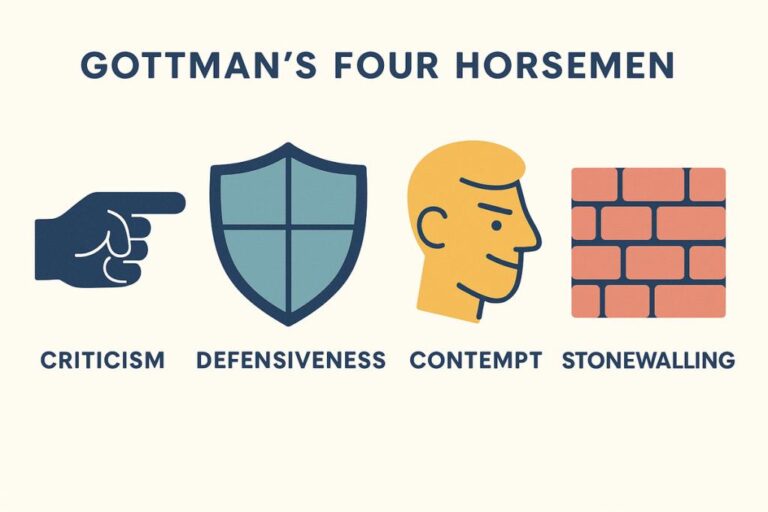
The 4 Communication Patterns That Hurt Relationships
Criticism: When Complaints Become Personal Attacks
Criticism is one of those things that’s hard to define, but you’ll know it when you hear it. Especially in Western culture, criticism is often used as a way to communicate our dissatisfaction with something. Most of us did not learn to share how we felt or were affected by things, so we point out the external behaviors or people that are causing problems. Criticism usually starts with “you always…” or “you never…” and frames something your partner did as a character flaw–something that is a defect in them. Forgetting to take out the trash turns into, “You never help around the house! I ask you all the time to do this one thing and you’re too scatterbrained to remember!” When complaints are communicated using criticism, the listener hears an accusation. They feel blamed, at fault, and attacked. And when you feel attacked, most people’s natural response is to defend themselves.
Defensiveness: Why We Get Defensive During Arguments
Defensiveness can show up in a few different ways, but its main purpose is to deflect blame. Again, if one person believes their partner is attacking them, they may use many different strategies to try and level the playing field. Explaining your position to justify your behavior, going for a counter-attack (“Oh yeah? Well what about when you…”), dismissing or minimizing someone’s feelings, and overintellectualizing are all examples of how defensiveness can show up during conflict.
Contempt: The Communication Habit That Erodes Trust
Contempt is like criticism’s older, meaner sibling. It usually appears when one partner believes they are “better” than the other in some way. They take a position of superiority over their partner, and usually look down on them or cast judgment from that position. On the receiving end, contempt feels belittling, condescending, and people often report feeling “small.” Left unchecked, this Horseman is one of the most dangerous for a relationship because it erodes the sense of safety and trust each partner has when speaking to the other. It’s hard to encourage someone to be vulnerable and share their deepest desires when they expect to be put down or ridiculed for their beliefs.
Stonewalling: When Your Partner Shuts Down During Conflict
Stonewalling got its name for a reason–when you’re talking to someone who uses this Horseman, it’s like talking to a stone wall. This looks like a lack of engagement with very few nonverbal cues of listening. Someone who is stonewalling might sit next to their partner on the couch, but be completely checked out of the conversation. The Gottmans’ research notes that, in men, this usually presents as looking away & focusing their attention elsewhere. On the other hand, women tend to maintain eye contact, but may have a blank stare when looking at their partner. Stonewalling is usually a sign that someone is flooded (AKA they’ve slipped into fight-or-flight territory) and is trying to protect themselves.

How the 4 Horsemen Create a Cycle of Conflict in Relationships
When couples fall into the Criticism-Defensiveness loop, the criticizing partner is almost always trying to communicate an unmet need. They try to voice their concerns in the only way our society has taught them, which understandably provokes a defensive response in their partner. The defensive partner doesn’t believe they’re totally to blame, so they respond by correcting their partner’s point of view or pointing out times when the criticizing partner was guilty of the same complaint. Obviously, this frustrates the criticizing partner and leaves them feeling unheard about their initial concern, so they return with more examples of times when their need wasn’t met, of course, sprinkling critical statements & assumptions about their partner throughout their story. And on and on the cycle goes.
When couples get stuck in the Contempt-Stonewalling loop, the contemptuous partner may feel let down by their partner’s consistent lack of support in one area of their relationship. Maybe it’s managing finances, helping around the house, or showing up as a parent. They see their partner “dropping the ball” a lot, and it frustrates them. No matter how many times they’ve tried to ask for things to be different, nothing seems to change. So, they start to feel resentment, and this seeps into how they communicate with their partner. There’s anger, frustration, powerlessness, and a general longing for things to be better. Meanwhile, the stonewalling partner can’t seem to have a moment of peace. Whenever they try to talk to their partner, the conversation always comes back to their shortcomings. They believe their partner doesn’t understand their feelings & only wants things their way. The stonewalling partner usually doesn’t think speaking up will make a difference–it’ll just lead to another unresolved fight where their partner will say or do hurtful things, so why bother? Shutting down seems like an easier way to maintain their peace, but over time, this peace comes at the expense of the relationship.
How to Break Unhealthy Communication Patterns as a Couple
There’s a reason the Four Horsemen are so dangerous to a relationship, and that’s because they get in the way of the couple’s ability to communicate their needs, feel understood, share differing beliefs, and find compromise. It can feel especially challenging to be trapped in these cycles when you love and care for your partner, but don’t know what to do differently.
If this sounds like something you experience in your relationship, good news, you’re in the right place! Noticing these patterns showing up during arguments with your partner is an extremely important first step towards change. You can’t work on improving something you aren’t aware of, so if you’ve identified the Horsemen as a struggle in your relationship, you’ve already started doing something different.
While these communication patterns can make couples feel stuck, there is a way out. Be sure to follow along because our next blog post will go into more detail about the Antidotes to the Four Horsemen and how you can start making small, everyday changes to better your relationship.
Recent Posts

Contact Us Today to Learn More!
If you learned something new from our blog and need help putting it into action in your own relationship, we’re always happy to help.
Reach out today to book an appointment and receive one-on-one support from our therapists!